ATMO-Trace: Advanced tracing and quantification of complex emissions
ATMO-Trace is our advanced methodology for quantifying emissions from complex and diffuse sources such as industries, shipping or agriculture. It applies reverse atmospheric dispersion modelling (RDM) to trace measured pollutant concentrations back to their emission sources providing location specific, data-driven emission estimates with quantified uncertainty.
Why ATMO-Trace matters
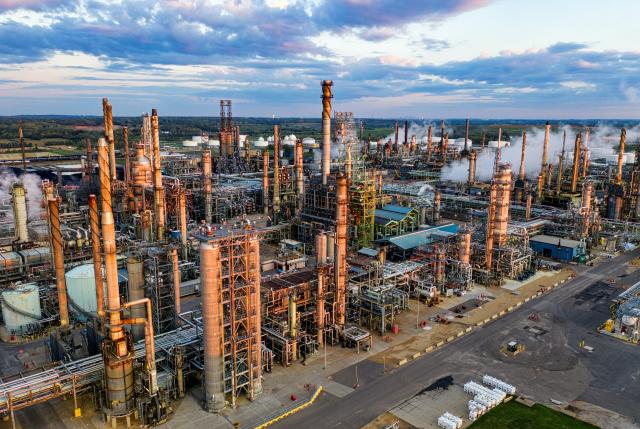
Complex emissions can originate from diffuse sources within an industrial site or from multiple sources distributed across a wider area, such as agricultural activities, shipping and residential combustion. Unlike emissions released through a well-defined point such as a stack or chimney, these emissions are generally difficult to measure and quantify directly.
Their spatial and temporal variability, combined with uncertainties in source activity and emission factors, can result in considerable uncertainty in conventional emission inventories.
ATMO-Trace provides an alternative, indirect approach: instead of measuring emissions directly at the source, it uses measured pollutant concentrations and atmospheric dispersion modelling to trace and quantify the emissions that best explain the observations.
This enables industries and policymakers to:
- Quantify uncertain or poorly characterised emissions using real-world air quality observations.
- Identify and better characterise emission sources and spatial emission patterns.
- Improve emission inventories and reporting with updated site specific emissions and quantified uncertainty.
- Target mitigation measures more effectively by providing a stronger evidence base for where emission reductions are needed.
What ATMO-Trace delivers
Depending on the application, ATMO-Trace provides source- or area-specific emission estimates, identification of important emission locations, spatial emission patterns and quantified uncertainty.
Results can be used to improve emission inventories, support regulatory assessments and provide better input for air quality modelling.
Applications
ATMO-Trace can be applied across a wide range of diffuse and complex emission environments:
- Chemical and petrochemical industries – VOCs and other diffuse or fugitive emissions from process areas, storage, loading and handling activities.
- Oil and gas facilities – methane and VOC emissions from production, processing, storage and associated infrastructure.
- Agriculture – ammonia and methane from livestock, manure management and other spatially distributed agricultural activities.
- Shipping and ports – VOCs and other emissions from maritime and inland shipping, cargo handling and port activities.
- Residential combustion – particulate matter and other pollutants from secondary heating sources such as wood and other solid-fuel burning.
- Complex industrial sites – heavy metals, particulate matter and other pollutants where multiple or poorly characterised sources contribute to measured concentrations
Supporting regulatory requirements
ATMO-Trace can provide improved emission information to support monitoring, reporting, permitting and environmental assessment under a range of European regulatory frameworks and standards, including:
- Industrial emissions – Industrial Emissions Directive (IED) and EN 17628:2022
- Methane – EU Methane Regulation (EU) 2024/1787
- Agriculture & ecosystems – NEC Directive · Habitats Directive / Natura 2000
- Air quality – Revised Ambient Air Quality Directive (EU) 2024/2881