
A new study highlighted by the European Commission’s Science for Environment Policy service demonstrates how advanced urban air quality modelling can significantly improve understanding of traffic-related pollution in cities. The research, carried out in Warsaw by partners from the Institute of Environmental Protection – National Research Institute (IOS-PIB) and VITO’s ATMOSYS team, shows that accounting for “street canyon effects” and “road dust resuspension” can dramatically improve air quality assessments in urban environments.
The study, recently published in Atmospheric Environment, used VITO’s ATMO-Street model as a key component in a new modelling chain developed for Warsaw. The work focused on better distinguishing between pollution caused by road traffic and emissions from residential heating — both major contributors to poor air quality in Central and Eastern European cities.
Bringing street-level detail to urban air quality modelling
Traditional urban air quality models often struggle to capture the complexity of pollution at street level. Buildings can trap pollutants in narrow streets — a phenomenon known as the “street canyon effect” — while traffic can continuously resuspend fine dust particles from road surfaces back into the air.
To address this challenge, ATMO-Street was combined with the Polish GEM-AQ chemical transport model, which served as the regional background model. Together, the models enabled detailed simulations of pollutant dispersion and chemical processes across Warsaw.
VITO worked closely with IOS-PIB to adapt ATMO-Street to the Warsaw urban environment and to include the important contribution of road dust resuspension. This adaptation allowed the research team to better quantify traffic-related emissions and their interaction with local urban geometry.

Significant improvements in model accuracy
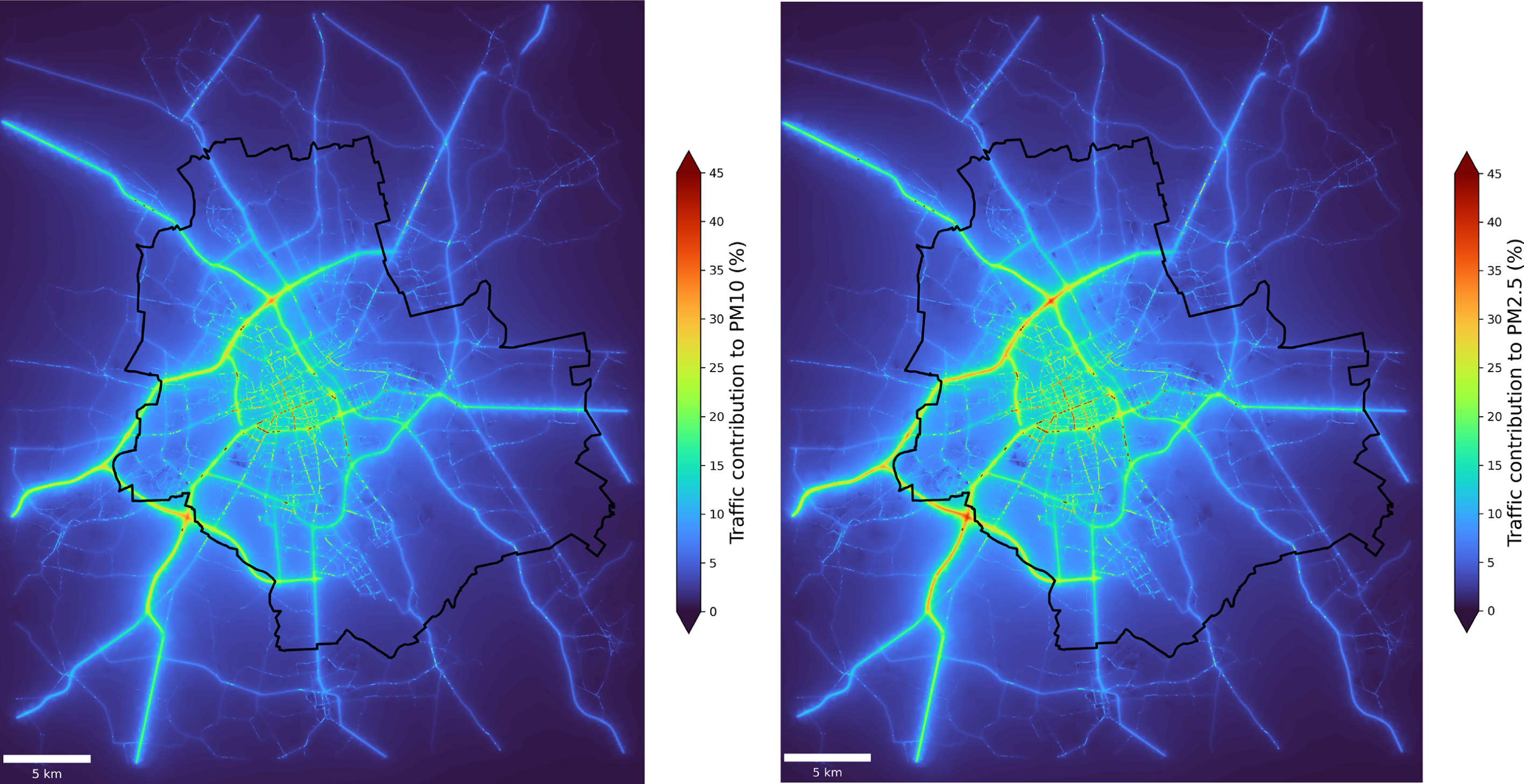
The results showed that including street canyon effects and road dust resuspension substantially improved the accuracy of air quality simulations. Compared with previous modelling approaches, the enhanced model chain improved agreement with monitoring data for particulate matter concentrations by 34% for PM2.5 and 55% for PM10.
The study also revealed that traffic contributed far more to particulate matter concentrations at roadside locations than previously estimated. At the traffic monitoring station in Warsaw, road transport accounted for:
-
41% of PM2.5 concentrations
-
42% of PM10 concentrations
-
84% of NO2 concentrations
These findings underline the importance of detailed urban-scale modelling for designing effective air quality policies and targeted mitigation measures.
Supporting Europe’s zero-pollution ambitions
The work comes at an important moment for European air quality policy. The revised Ambient Air Quality Directive calls for stronger urban monitoring networks and improved assessment tools to support the EU’s zero-pollution ambition for 2050.
By combining advanced modelling techniques with urban monitoring data, tools such as ATMO-Street can help cities better understand the real sources of pollution and identify the most effective interventions.
The Warsaw study demonstrates how collaboration between research institutes and modelling experts across Europe can support evidence-based environmental policymaking and healthier urban environments.