
Policy support for the nitrogen deposition reduction plan of Flanders
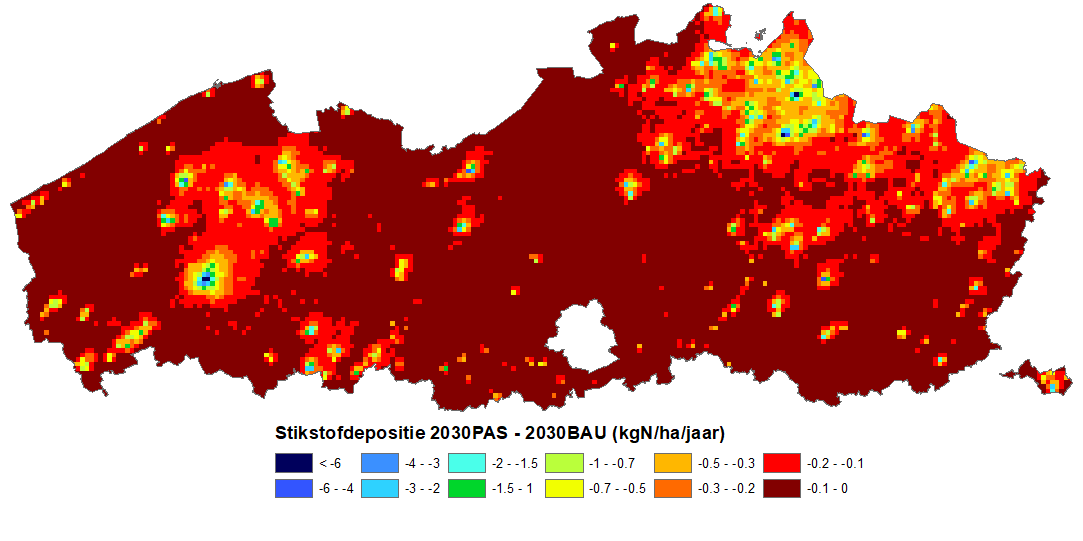
A major bottleneck for the quality of a lot of protected nature is formed by the deposition of acidifying and eutrophying substances via the air. These substances come mainly from agriculture (ammonia), traffic and industry. In Flanders, this problem is addressed by the Programmatic Approach to Nitrogen (PAS).
As part of a long running framework contract, VITO supports the Flemish Agency for Nature and Forests and the Flemish Department of Environment and Spatial Development in the development of this Programmatic Approach to Nitrogen for Flanders. This includes the development and application of methods for the high-resolution modelling of atmospheric nitrogen deposition to protected nature areas (Natura 2000 network) in Flanders in order to support the implementation and management of the EU Habitats Directive in the region of Flanders.
The key activities being supported include:
- High-resolution modelling of nitrogen deposition to the Flemish Natura 2000 sites
- Source allocation of nitrogen deposition on regional and local scale
- Development of IT tools to calculate nitrogen deposition from agricultural sources
- Development of IT tools to report and analyse nitrogen deposition in Flanders
- Scenario analyses in order to define strategies to meet future targets with respect to nitrogen deposition
- Validation of model runs
- Sensitivity studies
International benchmark and validation study
VITO took part in a benchmarking and validation study led by the Dutch National Institute for Public Health and the Environment (RIVM) to assess the degree of uncertainty in the calculation of nitrogen deposition with operational atmospheric transport models such as IFDM.
As part of the benchmark study, eight different models were run for a single source – a livestock barn, manure application, a factory and a motorway – and different land cover types to assess how the various models compare with one another. A benchmark study merely indicates where and when models differ significantly, not what the correct answer is.
A validation study was therefore also carried out in which the eight models and their ensembles were compared with measurements. The first measurement campaign focused on concentration and deposition in the vicinity of two poultry houses, the second on the concentration near a motorway and the third on the concentration in the vicinity of industry. Only one suited campaign with deposition measurements, showing lower accuracy than the concentration measurements, was found for validating model outcomes.
The spread between the outcome of the different models was quantified using the geometric mean and geometric standard deviation, which are more appropriate metrics when the distribution of outcomes is close to a log-normal distribution.
Benchmark study
The benchmark showed that, in terms of concentrations, IFDM produces higher values than most other models in the immediate vicinity of a livestock barn. For the motorway, IFDM tends to be at the lower end of the model ensemble. For manure application and for the industrial case, IFDM lies in the middle of the ensemble.
On the other hand, for depositions, IFDM is always towards the lower end of the ensemble and is virtually never an outlier.
Validation study
The results of the validation study showed that IFDM ranks among the best models investigated. For none of the concentration validations (livestock barn, motorway, industrial source) does IFDM show significant biases or large deviations. This is visible on the figure below, showing the pink dot of IFDM in the middle of the plot for most cases.
Admittedly, IFDM shows slightly higher ammonia deposition levels than those measured with the Ringsted campaign, but as the validation report points out, the uncertainty in the deposition measurements is extremely high in this case. In any case, all models produced poorer results for the deposition measurements at Ringsted than for any of the concentration measurements. This is probably due to the fact that (i) modelling deposition is inherently more complex than modelling concentrations, and (ii) deposition measurements are less accurate than concentration measurements.
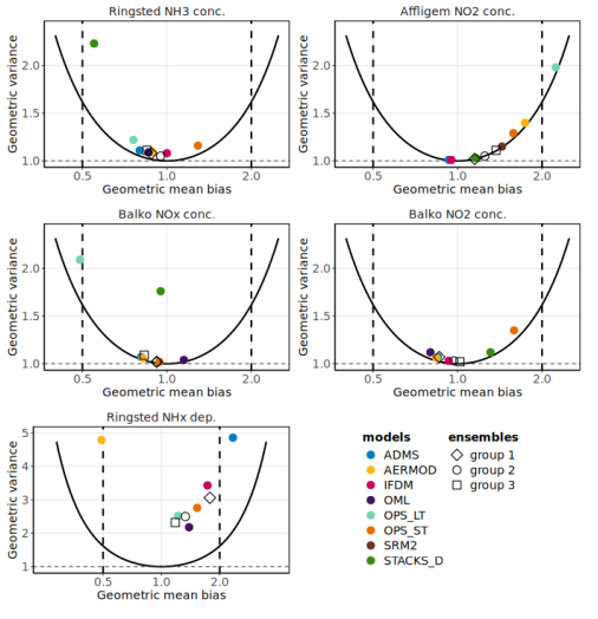
The study also showed that, for all concentration cases examined, IFDM achieves a perfect score according to the Chang and Hanna criteria, a performance metric frequently used for atmospheric transport models. This indicates that the model is performing well. Furthermore, ensemble models do not yield better results than the best-performing model, whether in terms of concentration (IFDM) or deposition (OML, OPS_LT).
References
Validation of IFDM at short distances of open stables in Flanders
The RIVM study focused on the uncertainty associated with model formulations, particularly those of VITO’s IFDM model. In addition to the uncertainty inherent in the models, the uncertainty associated with the input data – particularly regarding emissions – is also significant. This is especially true for open livestock housing, which accounts for a significant proportion of ammonia emissions in Flanders. Therefore, this study examines what lessons we can draw from a measurement campaign of the emissions of open stables in relation to the validation of IFDM.
Ammonia emission measurements were carried out at a number of open cattle sheds (by the Institute for Agricultural, Fisheries and Food Research Institute, ILVO), as well as sampling of the ammonia concentration in the vicinity of these stables (by ILVO and the Flemish Environment Agency, VMM).
- IFDM provides reliable results for open stables. Validation shows that the model meets internationally accepted performance criteria when emission sources are represented appropriately, making it suitable for use in environmental assessments.
- Accurate representation of emission sources is essential. Wide line sources provide the most realistic representation of livestock buildings within the model. Simpler approaches, such as point sources, reduce accuracy and can lead to biased results, particularly for open barns.
- Local conditions strongly influence measurements. Emissions from nearby livestock buildings and the exact location of barns can significantly affect measured concentrations. As a result, assessing a single livestock building in isolation has important limitations.
- Very short-distance predictions remain uncertain. The largest differences between modelled and measured concentrations occur close to sources such as barns, where airflow around buildings creates complex dispersion patterns. These areas are therefore excluded from permitting assessments.
- CFD simulations improved understanding of emission dispersion from open cattle stables. The results of the simulations in the figure below show that ground-level concentrations are mainly driven by emissions from the side openings rather than the roof. This confirms that representing open cattle stables as point sources is not appropriate. In contrast, emissions from closed stables released through the roof can be affected by building downwash.
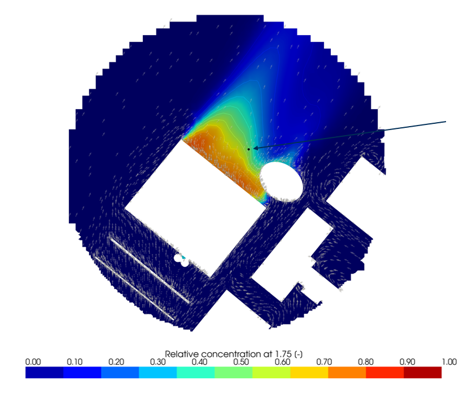
The study confirms that no changes to the IFDM model are required. Future improvements should focus on clearer guidance for its application in permitting and impact assessment tools, rather than modifying the model itself.
References
ILVO measurement campaign (only in Dutch): ILVO (2025). Meetcampagne voor de bepaling van de ammoniakemissies van een traditionele melkveestal. ILVO report D/2025/06.
VITO validation report (only in Dutch): VITO (2025). Validatie IFDM voor melkveestallen. VITO report 2025/EI/R/3498.


Client: Flemish Agency for Nature and Forests (ANB) and Flemish Department of Environment and Spatial Development
Year: 2015 - ongoing